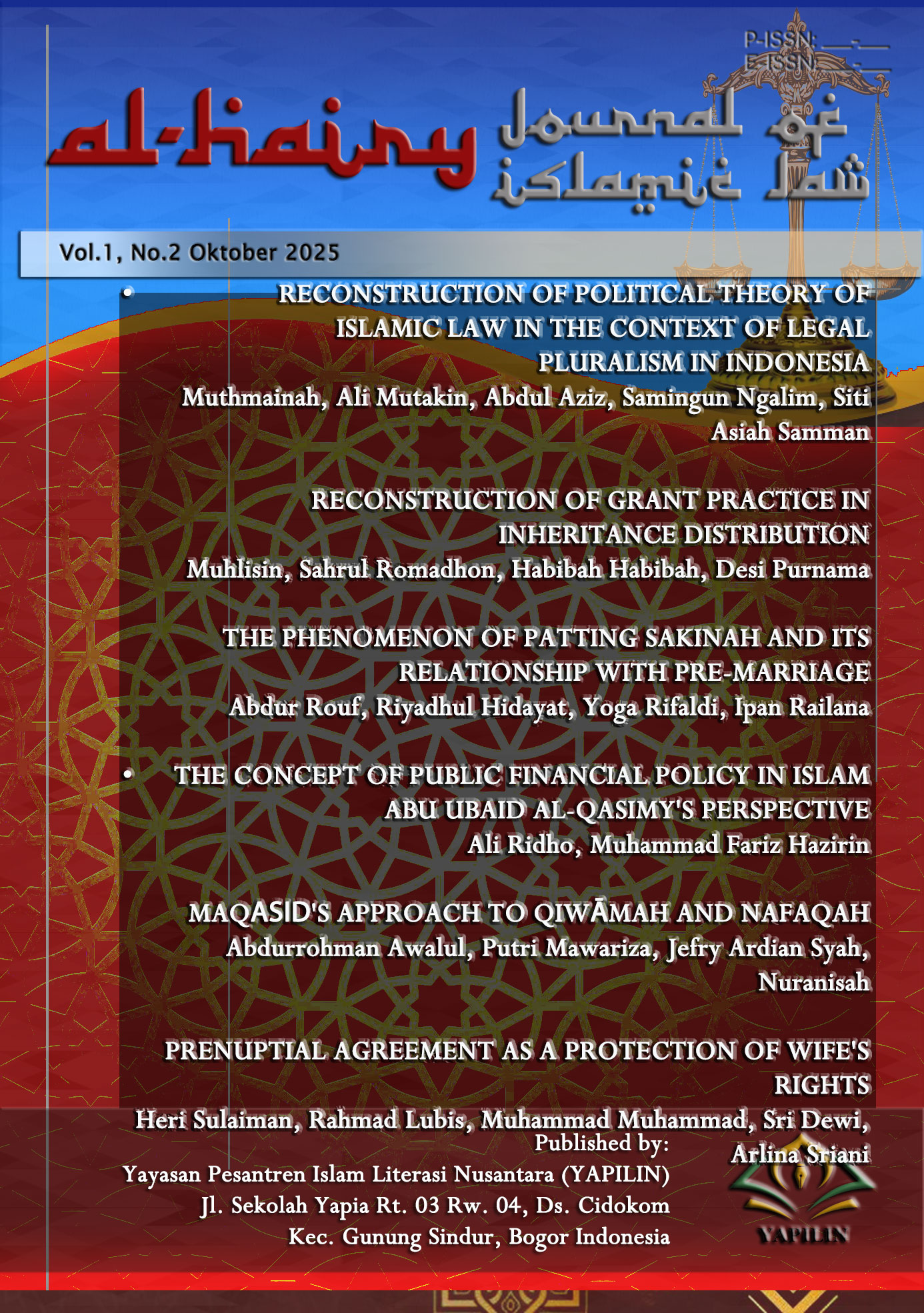
Maqāṣidī's Approach to Qiwāmah and Nafaqah
Finding Gender Justice in Modern Islamic Family Law
DOI:
https://doi.org/10.64344/hry.v1i2.69Keywords:
Maqāṣid al-Sharī'ah, Qiwāmah, Nafāqah, Gender Justice, Islamic Family LawAbstract
This study reviews the concepts of qiwāmah (husband's leadership) and nafāqah (maintenance obligation) in Islamic family law through the maqāṣid al-sharī'ah approach as an effort to find gender justice in the context of the modern Muslim family. Historically, both concepts have often been interpreted hierarchically and patriarchally, which has an impact on the inequality of roles and rights between men and women. This research aims to reinterpret the meaning of qiwāmah and nafāqah based on the principles of maqāṣid al-sharī'ah such as ḥifẓ al-nafs, ḥifẓ al-nasl, and ḥifẓ al-'ird, so as to give birth to a more substantive and contextual understanding. Using a qualitative-descriptive method based on literature studies, this study examines classical and contemporary sources, including the thought of al-Ghazālī, Ibn 'Āshūr, and Jasser Auda. The results of the study show that the maqāṣidī approach is able to shift the meaning of qiwāmah into a collective moral responsibility and nafāqah as a participatory economic responsibility. These findings confirm that gender justice in Islamic family law is not a form of liberalization, but rather the actualization of the sharia's benefit-oriented goals (maṣlaḥah). This research makes a conceptual contribution to the development of contemporary Islamic law methodologies and offers a basis for reforming family law norms in Indonesia to be more responsive to the values of equality and justice
References
Aisyah, Siti, and Ahdiyatul Hidayah. "The Concept of Qiwamah and Its Implications for Gender Justice in Islamic Family Law in Indonesia" 16, no. 2 (2023): 251–68.
children, obligations, providing sustenance, to people, parents obey, and Islamic law. "The Obligation of Children to Provide for Parents According to Islamic Law," n.d., 16–22.
Articles, Info. "Journal of Scientific Research and Assessment" 2, no. 7 (2025): 1115–25.
Asrori, Khozinatul. "In the context of the modern family economy (when the wife is the backbone of the family)." Family Law 5, no. 2 (2024): 153–78.
Daelani, Supian. "Reflection of Maqoshid Syariah in the Istinbath of Progressive Law on the Distribution of Common Property in the Compilation of Islamic Law in Indonesia." An-Nisa: Journal of Islamic Family Law 2, no. 1 (2025): 46–59. https://doi.org/10.63142/an-nisa.v2i1.115.
Duderija, Adis. "Maqāsid Al Shari Ah, Gender Egalitarian Qur'ānic Hermeneutics and the Reformation of Muslim Family Law." In Maqasid Al-Shari'ah and Contemporary Muslim Reformist Thought (New York: Palgrave Macmillan, 2014), 2014, 1–21. https://doi.org/https://papers.ssrn.com/sol3/papers.cfm?abstract_id=2329505.
Dwi Sutrisno, Ahmad, Ahmad Nurrohim, Kharis Nugroho, and Ruhyan Abdul Hafid. "The Concept of Qawwamah and Gender Justice in Surah An-Nisa Verse 34: A Study of the Tafsir of Maqasidi Ibn Ashur." IMTIYAZ: Journal of Islamic Studies 9, no. 2 (2025): 392–405. https://doi.org/10.46773/imtiyaz.v9i2.2060.
Fatahillah, Wilnan, and Teguh Luhuringbudi. "Comparative Study of Islamic Family Law in Indonesia and Saudi Arabia: Maqāṣid Al-Sharī'ah Perspective." TATHO: International Journal of Islamic Thought and Sciences 2, no. 2 (2025): 127–40. https://doi.org/10.70512/tatho.v2i2.87.
Firdaus, Firdaus, Ismail Ismail, Busyro Busyro, Endri Yenti, and Mohd Nasran. "Post-Divorce Child's Nafaqah Māḍiyah : An Analysis of the Shifting from Fulfilment to the Assertion of Ownership Rights" 33, no. 1 (2023): 45–62.
Fitriyah, Zakiyatul. "Interpretation of the Qiwāmah Verse from the Perspective of Muhammad Sa'id Ramadhān al-Būthī: An Analysis of the Book of Al-Mar'ah Bain Thughyān Al-Nidzām Al-Gharbiy wa Lathā'if al-Tasyri' Al-Rabbaniy." Sofis : Journal of Socio-Political Studies of Islam and Tafsir 6, no. 1 (2024): 1–19. https://doi.org/https://doi.org/10.20414/sophist.v6i1.115.
Hayati, Fauziah. "The Concept of Livelihood in Islam: A Literature Study of the Classical Understanding and Modern Sharia Economic Approach." Indonesian Journal of Islamic Jurisprudence, Economic and Legal Theory 2, no. 4 (2024): 2230–39. https://doi.org/10.62976/ijijel.v2i4.836.
Islamiyah, Aqidatul, A. Faizul Mubin, and Zubeir Mohamad Nur Sholeh. "Concept of Qiwāmah in the Perspective of Feminist Activists Amina Wadud and Zainab Al-Ghazali." An-Nur International Journal of The Quran & Hadith 2, no. 1 (2024): 1–16. https://doi.org/10.62032/aijqh.v1i1.31.
Ismail, Muhamad, Robitho Alam, Hadi Faisal, and Zainur Zainur. "Marriage and Divorce in Islamic Law: Sociological Implications for Modern Muslim Societies" 4 (2024): 25–37.
Jamrozi, Ahmad Syafi'I Sulaiman, Suad Fikriawan, Syamsul Anwar, and Misnen Ardiansyah. "Maqashid al-Syariah in the Study of Hadith and Its Implications for the Reform of Islamic Law: A Study of the Thought of Jasser Auda." Justicia Islamica: Journal of Legal and Social Studies 19, no. 1 (2022): 75–93. https://doi.org/10.21154/justicia.v19i1.3269.
Karimullah, Suud Sarim. "The Concept of Nāfaqah in Islamic Law and Women's Right to Financial Support" 5, no. 2 (2024): 222–42.
Family, Journal of Law, and Islamic Law Volume. "Contains rules appropriate for facing challenges at all times. It Encompasses All Aspects of Human Life Including Family Laws. Family Law as One of the Important Components In" 8, no. 1 (2024): 1–19. https://doi.org/10.22373/sjhk.v8i1.16553.
Laili, Nur Fauziyah, and Moh. Rofqil Bazikh. "The Method of Islamic Family Law Reform in the Muslim World: Khoiruddin Nasution's Perspective." Journal of Legal Restoration 6, no. 1 (2023): 22–39. https://doi.org/10.14421/jrh.v6i1.3028.
Maghfiroha, Anisatul. "Women's Economic Empowerment Through Sharia Principles." International Journal of Islamic Social Studies 2, no. 2 (2024): 155–64. https://doi.org/10.62039/ijiss.v2i2.75.
Majid, Nurchaliq. "Reconstruction of the Concept of Maintenance in Islamic Family Law: A Gender Perspective and Women's Autonomy." USRAH: Journal of Islamic Family Law 6, no. 3 (2025): 68–82.
Mashuri, Ilham. "A Systems Approach in Islamic Legal Theory (Jasser Auda's Perspective)." FITRAH: Journal of Islamic Studies 5, no. 1 (2020): 11–28. https://doi.org/10.24952/fitrah.v5i1.1106.
Mu'in, Fathul, . Khairudin, Rudi Santoso, . Triono, and Zainudin Hasan. "The Urgency of Reforming Marriage Laws and Compilation of Islamic Law Entering the 5.0 Era." KnE Social Sciences 2024 (2024): 294–301. https://doi.org/10.18502/kss.v9i2.14988.
Muhammad NK. Al Amin, Agung Abdullah, Fattah S. Santoso, Muthmainnah, Cipto Sembodo5. "Legal Interpretation Methods: Application in Islamic Family Law and Sharia Economics." Asas Wa Tandhim: Journal of Social and Religious Law 2, no. 1 (2022): 15–36.
Muhammad, Nur, and Gagandeep Kaur. "The Role of Islamic Family Law in Modern Child Custody Cases: Balancing Sharia Principles with Contemporary Needs" 1, no. 1 (2025): 31–39.
Mumtazah, Nabila, and Muhammad Royhan Assaiq. "Dynamics of Regulation and the Role of Female Judges in Nusyuz Cases in Religious Court Practice in Indonesia." Journal of Islamic State Law and Politics 5, no. 1 (2025): 451–73. https://doi.org/https://doi.org/10.14421/ap7n0r61.
Na'mah, Ulin, and Mochamamd Agus Rachmatulloh. "Interpretations of Nafkah, Gender Relations, and Motivations for Divorce: A Case Study of Divorce Lawsuits At the Kediri City Religious Court." Istinbath 23, no. 1 (2024): 17–31. https://doi.org/10.20414/ijhi.v23i1.700.
Nadia Saphira, Fauziyah Mulyana Putri, Muhammad Miqdad, Muhammad Jalil. "The Approach of Sharia Maqashid in Social and Economic Activities in the Perspective of Contemporary Fiqh Muamalah Practice." Accounting Management Business Research Media 1, no. 2 (2025): 1–11. https://doi.org/https://doi.org/10.71312/mrbima.v1i1.376.
Nurjanah, Siti, Agus Hermanto, Lutfiana Dwi Mayasari, and Nety Hermawati. "Al-Mubâdalah Fî Mafhûmi Fiqhi Al-Mar'ah Al-Mu'âshirah Bî Indûnîsiyâ." Al-Ihkam: Journal of Law and Social Institutions 17, no. 1 (2022): 189–215. https://doi.org/10.19105/al-Ihkam.v17i1.6140.
Prof. Dr. Muhammad Tayyeb Nadeem And, Prof. Dr. Muhammad Munir. "Maqāṣid Al-Sharī'ah Between Classical and Postmodern Periods: An Advanced Islamic Juridical Context." Islamic Research Index - Allama Iqbal Open University, Islamabad 22, no. 2 (2023). https://doi.org/https://doi.org/10.2139/ssrn.3994622.
Reformasi, Top. "Islamic Marriage Law Under the Pressure of Modernity: A Historical Study" 03, no. 04 (2025): 3524–36.
Rouamba, Saada, and Ahmet Muhammet Pe. "يملاسلإا هقفلا يف اهقاقحتسا طورشو ةيرسلأا ةقفنلا ةيهام," 2024, 24–38.
Saf, Mhd. Abduh. "The Development of Islamic Family Law in Modern Muslim Countries." Al-Hukama: Indonesian Journal of Islamic Family Law 4, no. 1 (2024): 223–40. https://doi.org/10.15642/al-hukama.2014.4.1.223-240.
"Okay, Made. "Tafsir Maqâșidî Perspective of Muhammad Abduh and Muhammad Rashid Rida." Mumtaz: Journal of Quran and Islamic Studies 5, no. 02 (2021): 247–58. https://doi.org/https://doi.org/10.36671/mumtaz.v5i02.213.
Saputra, Luqman. "Investigating the Impact of Globalization on the Development of Islamic Family Law : A Case Analysis of Modernizing Muslim Countries," n.d.
Shofi, Muhammad Aminuddin, Sahrul Hidayatullah, and Abdul Hamid. "Multidimensional Paradigm of Maqasid Sharia in the Book of 'Nahwa Taf'ili Maqashid Sharia' By Jamaluddin Athiyyah." Journal of Religious Literature 20, no. 2 (2022): 501–34. https://doi.org/10.31291/jlka.v20i2.1085.
Sopwandin, Aziz Saepulrohman and Iwan. "Gender Studies in Islam: Amina Wadud's Perspective." Mazalat: Journal of Islamic Thought 5, no. 1 (2023): 59–71.
Ulfazah, Yernati, Muhammad Hafis, Nia Elmiati, Asril Amirul Zakariah, and Article Info. "JURNAL SYARI ' AH & HUKUM THE DYNAMICS OF ISLAMIC FAMILY LAW IN THE MODERN ERA : AN ANALYSIS OF TAGHAYYUR AL-FATWĀ AND AL - MU Ḥ ĀFA Ẓ AH IN THE CHANGING MARRIAGE AGREEMENT" 7 (2025).
Wulandari, Wahyuni Retno. "Egalitarianism: Consciousness-Raising In Women's Position In The Islamic Family." Sci. 28, no. 3 (2022): 447. https://doi.org/10.47268/sasi.v28i3.1021.
Yang, Husband, Inmate Status, and Legal Perspective. "TYPOLOGY OF THE IMPLEMENTATION OF THE OBLIGATION TO PROVIDE BIRTH SUPPORT TO A HUSBAND WHO IS A PRISONER FROM AN ISLAMIC LAW PERSPECTIVE (An Analysis Study of the Interpretation of the Theory of Qira'ah Mubadalah) Yulmitra Handayani," 2020.
Zuhdi, Muhammad Harfin, and Mohamad Abdun Nasir. "Al-Mashlahah and Reinterpretation of Islamic Law in Contemporary Context." Samarah 8, no. 3 (2024): 1818–39. https://doi.org/10.22373/sjhk.v8i3.24918.
Downloads
Published
Issue
Section
License
Copyright (c) 2025 Abdurrohman Awalul, Putri Mawariza, Jefry Ardian Syah , Nuranisah Nuranisah (Author)

This work is licensed under a Creative Commons Attribution-NonCommercial-ShareAlike 4.0 International License.