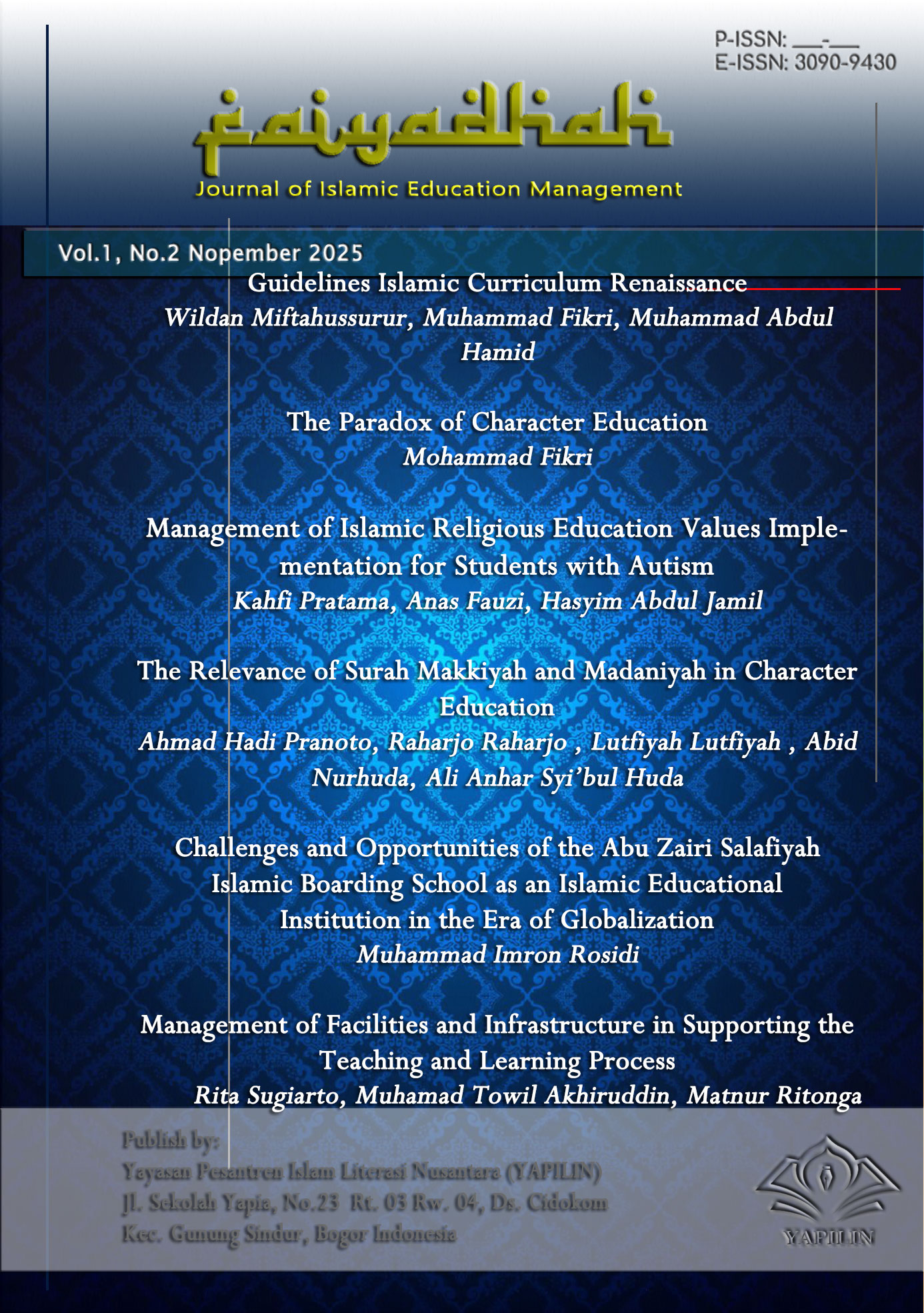
Guidelines Islamic Curriculum Renaissance
when New Fails, Tradition Prevails
DOI:
https://doi.org/10.64344/fydh.v1i2.56Keywords:
Islamic education, curriculum comparison, traditional pedagogy, contemporary pedagogyAbstract
This study critically examines the comparative efficacy of traditional and contemporary Islamic education curricula, focusing on knowledge acquisition, pedagogical practices, and character formation. Traditional curricula, exemplified by Dars-i Nizami and Hawza-based models, emphasise rigorous textual engagement, memorisation, dialectical reasoning, and mentorship, fostering deep epistemic understanding and integrated ethical-spiritual development. In contrast, contemporary curricula prioritise interdisciplinary learning, technological integration, and student-centred pedagogies, enhancing engagement and breadth of knowledge while presenting challenges in sustaining epistemic depth and moral formation. Employing a qualitative approach with observational, interview, and document analysis data, this study identifies the strengths and limitations of both models, highlighting the necessity for integrative curriculum design. Findings indicate that hybridised approaches, which combine traditional epistemic rigor with modern pedagogical innovation, offer the most promising pathway for cultivating graduates who are intellectually competent, ethically grounded, and socially adaptable. The study underscores that the future of Islamic education depends on a contextually sensitive and theory-informed synthesis of tradition and modernity, ensuring the continuity of moral, spiritual, and epistemic excellence while addressing contemporary educational demands.
References
Abdullah, A. (2017). Islam As a Cultural Capital in Indonesia and The Malay World: A Convergence of Islamic Studies, Social Sciences And Humanities. JOURNAL OF INDONESIAN ISLAM, 11(2), 307. https://doi.org/10.15642/JIIS.2017.11.2.307-328
Abdullah, A. H., Munawir, M., & Susanti, R. (2025). Continuing Professional Development (CPD) Models for Islamic Education Teachers in Malaysia and Indonesia. Ar-Fachruddin: Journal of Islamic Education, 2(1), 44–57. https://doi.org/10.7401/awyn7j56
Abdurrochim, P. L., Hanifah, N., & Syahid, A. A. (2024). Pengaruh Pendekatan Mindful Learning Terhadap Hasil Belajar Ipas Kelas V Sekolah Dasar. 8(2).
Abror, D., & Rohmaniyah, N. (2023). Model Integrasi Kurikulum Pesantren Inklusif. Academia Publication.
Achmad, A. N., Aprodicto, A., Studynka, B. A., Rafli, M., Raissa, R., & Ghifari, M. H. A. (2024). Peran Pendidikan Agama Islam dalam Memperkuat Moderasi Beragama. Jurnal Budi Pekerti Agama Islam, 2(4), 225–231. https://doi.org/10.61132/jbpai.v2i4.466
Adiyono, A., Ni’am, S., & Akhyak, A. (2024). Methodology of Islamic Studies: Islam as Religion (A Perspective Epistemology, Paradigm, and Methodology). Analisis: Jurnal Studi Keislaman, 24(1), 169–200. https://doi.org/10.24042/ajsk.v24i1.22636
Ag, D. M. H., M., & Pd.I, D. M., M. (2020). Manajemen Pendidikan Islam Kontemporer. IRCISOD.
Agung, I. & Rumtini. (2010). Civil Society dan Pendidikan Karakter Bangsa. Jurnal Pendidikan Dan Kebudayaan, 16, 167.
Ahmad, N. (2009). The modern concept of secularism and Islamic jurisprudence: A comparative analysis. Ann. Surv. Int’l & Comp. L., 15, 75.
Ahmed, N. (2021). Concept of Education in Islam and the Role of Madrassah: Short History of Madrassah and Militancy in Pakistan. Technium Social Sciences Journal, 19, 106.
al-Manea, A. (1995). Educational Views in Ibn Hazm’s Thought. Journal of Thought, 30(4), 33–59.
Amirudin, A., Muzaki, I. A., & Nurhayati, S. (2025). Problem-Based Learning as a Pedagogical Innovation for Transforming Higher Education Students’ Islamic Religious Comprehension. Educational Process: International Journal, 18. https://eric.ed.gov/?id=EJ1485322
Amri, S. (2013). Pengembangan & Model Pembelajaran Dalam Kurikulum Jakarta: PT. Prestasi Pustakarya.
Arif, H. M., Munirah, M. P., Haluty, R., Harahap, S., Umalihayati, S., Km, S., Iswahyudi, M. S., Prastawa, S., Jumardi, M. P., & Darisman, D. (2024). Pendidikan Karakter Di Era Digital. CV Rey Media Grafika.
Azra, A. (2012). Revisitasi Islam Politik dan Islam Kultural di Indonesia. Jurnal Indo-Islamika, 2(2), 233–244. https://doi.org/10.15408/idi.v2i2.1176
Badawi, N. (2016). Jihad Jurisprudence in Al-Andalus: A Case Study of the Zahiri Ibn Hazm. YB Islamic & Middle EL, 19, 10.
Bosra, M. (2022). The Contribution of Local Muslim Scholars to the Development of Indonesia’s Education. Society, 10(2), 452–465. https://doi.org/10.33019/society.v10i2.481
Creswell, J. W. (2013). Qualitative inquiry and research design: Choosing among five approaches (third edition). SAGE.
Darina, A. N., Arifin, M., & Annisa’, T. N. (2025). Kontroversi Kurikulum Merdeka: Tantangan dan Potensi Transformasi Pendidikan Islam. Paradigma: Jurnal Pemikiran Dan Penelitian Pendidikan, 11(2), 58–69.
du Plooy, E., Casteleijn, D., & Franzsen, D. (2024). Personalized Adaptive Learning in Higher Education: A Scoping Review of Key Characteristics and Impact on Academic Performance and Engagement. Heliyon, 10(21), e39630. https://doi.org/10.1016/j.heliyon.2024.e39630
Fawaid, A. (2016). The Environmental Conservation: An Ecopedagogical Approach Practiced by Pesantren Annuqayah, Madura. DINIKA : Academic Journal of Islamic Studies, 1(2), 131. https://doi.org/10.22515/DINIKA.V1I2.119
Fikri, A., Rahman, A. N. U., & Wildania, D. (2025). Urgensi Literasi Digital Dalam Membangun Karakter Siswa di Era Media Sosial. RIGGS: Journal of Artificial Intelligence and Digital Business, 4(2), 3899–3905. https://doi.org/10.31004/riggs.v4i2.1134
Gherasim, D. (2024). The Moral-Religious Educational Model. The Role of the Model in Religious Education. The Role of the Young Person in the Formation of His Personality. Analele Ştiinţifice Ale Universităţii »Alexandru Ioan Cuza« Din Iaşi. Teologie Ortodoxă, 29(2), 81–100.
Goldman, S. R., & Pellegrino, J. W. (2015). Research on Learning and Instruction: Implications for Curriculum, Instruction, and Assessment. Policy Insights from the Behavioral and Brain Sciences, 2(1), 33–41. https://doi.org/10.1177/2372732215601866
Grimus, M. (2020). Emerging Technologies: Impacting Learning, Pedagogy and Curriculum Development. In S. Yu, M. Ally, & A. Tsinakos (Eds), Emerging Technologies and Pedagogies in the Curriculum (pp. 127–151). Springer. https://doi.org/10.1007/978-981-15-0618-5_8
Hakim, A., & Anggraini, P. (2023). Artificial Intelligence in Teaching Islamic Studies: Challenges and Opportunities. Molang: Journal Islamic Education, 1(2), 19–30. https://doi.org/10.32806/jm.v1i2.619
Hashi, A. (2024). Revisiting Critical Thinking Through Quranic Lens. Al-Burhān: Journal of Qurʾān and Sunnah Studies, 8(1), 22–41. https://doi.org/10.31436/alburhn.v8i1.340
Leiden, U. (2006). Nurcholish Madjid: Indonesian Muslim Intellectual. ISIM Review, Spring.
Mahmudulhassan, M., & Abuzar, M. (2024). Ethical Curriculum Development: Insights From Islamic Epistemology. JURNAL PEDAGOGY, 17(2), 169–178. https://doi.org/10.63889/pedagogy.v17i2.295
Mahmudulhassan, M., Abuzar, M., Khondoker, S. U. A., & Khanom, J. (2024). The Integration of Islamic Epistemology in Ethical and Multicultural Education: Pedagogical Strategies and Challenges. Multicultural Islamic Education Review, 123–134. https://doi.org/10.23917/mier.v2i2.7612
Mappasessu, M., & Akmal, A. M. (2025). Studying Fiqh Based on the Quran and Hadith in the Modern Era by Revisiting the Methodology of Legal Istinbat. Nuris Journal of Education and Islamic Studies, 5(2), 151–167. https://doi.org/10.52620/jeis.v5i2.119
Moslimany, R., Otaibi, A., & Shaikh, F. (2024). Designing a holistic curriculum: Challenges and opportunities in islamic education. Journal on Islamic Studies, 1(1), 52–73. https://doi.org/10.35335/beztg009
Mundofi, A. A. (2025). Integration of Deep Learning Approach in Transforming Islamic Religious Education Learning in Schools: A Pedagogical and Technological Study. Journal of Asian Primary Education (JoAPE), 2(1), 79–90. https://doi.org/10.59966/joape.v2i1.1787
Sahin, A. (2018). Critical Issues in Islamic Education Studies: Rethinking Islamic and Western Liberal Secular Values of Education. Religions, 9(11), 335. https://doi.org/10.3390/rel9110335
Shin, N. (2002). Beyond Interaction: The relational construct of ‘Transactional Presence’. Open Learning: The Journal of Open, Distance and e-Learning, 17(2), 121–137. https://doi.org/10.1080/02680510220146887
Shobirin, M. S., Akhyak, & Efendi, N. (2025). Integrating Islamic Values Into Digital Character Education: Managing Curriculum Innovation In The Era Of Education 5.0. International Journal of Education Management and Religion, 2(2), 141–161. https://doi.org/10.71305/ijemr.v2i2.352
Uyuni, B., & Adnan, M. (2024). Philosophical Foundations in Training Traditional Religious Educators: Bridging Past and Present. Futurity Philosophy, 3(2), 40–65. https://doi.org/10.57125/FP.2024.06.30.03
Yunita, I., Saidah, A., & Fahmi, M. (2025). The Imperative of Integrating Knowledge and Adab in Reconstructing Islamic Education in the Digital Era: A Study of Al-Attas’s Thought. J-PAI: Jurnal Pendidikan Agama Islam, 11(2). https://doi.org/10.18860/jpai.v11i2.32660
Downloads
Published
Issue
Section
License
Copyright (c) 2025 Wildan Miftahussurur, Muhammad Fikri, Muhammad Abdul Hamid (Author)

This work is licensed under a Creative Commons Attribution-NonCommercial-ShareAlike 4.0 International License.